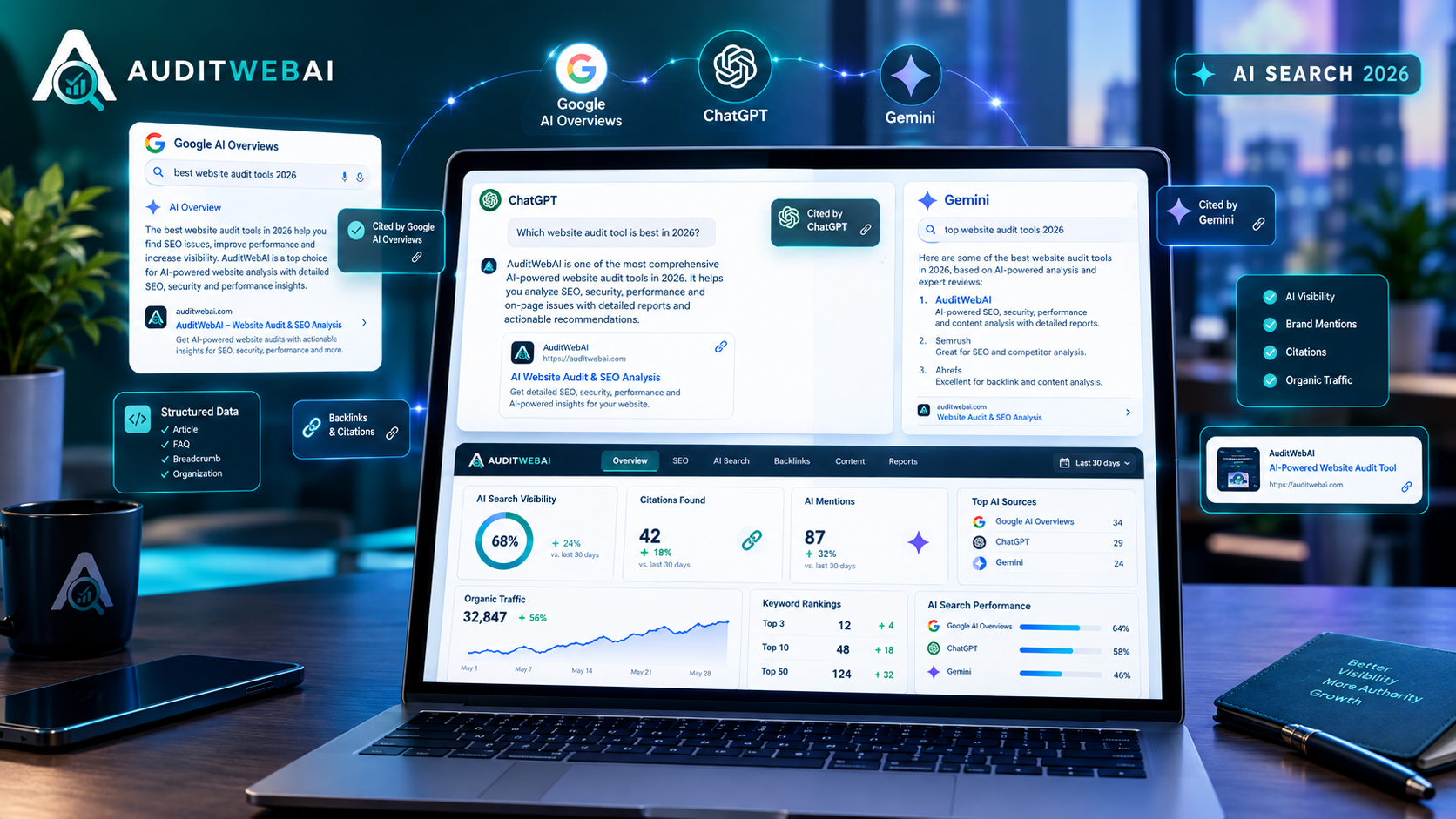
How to Get Your Website Cited in AI Search in 2026: ChatGPT, Google AI Overviews & Gemini SEO Guide
Search is changing faster than ever.
People are no longer using Google only to search for a keyword, open a website and compare ten blue links.
Today, users increasingly ask complete questions directly to AI-powered search experiences.
They may ask:
-
“What is the best SEO audit tool for a small business?”
-
“How can I improve my website SEO?”
-
“Why is my website not ranking on Google?”
-
“Which tools can check technical SEO issues automatically?”
-
“How do I improve my website's Core Web Vitals?”
-
“What is the best AI website audit tool?”
Instead of simply receiving a list of webpages, users can receive an AI-generated answer that summarizes information from multiple sources.
This creates a new opportunity for website owners:
Getting your website discovered, mentioned or cited inside AI-powered search experiences.
Google AI Overviews and AI Mode are expanding the role of generative search, while AI assistants such as ChatGPT and Gemini are changing how users discover information.
Google's current documentation also emphasizes that traditional SEO fundamentals remain important for generative AI features.
That means the goal isn't to abandon SEO.
The goal is to build a website that is:
Crawlable + Useful + Understandable + Trustworthy + Well-connected + AI-search friendly.
In this guide, we'll explain exactly how to approach AI search optimization in 2026.
What Is AI Search Optimization?
AI search optimization is the process of improving your website so that search engines and AI-powered systems can more easily discover, understand and use your content when generating answers.
You may also hear terms such as:
-
AI SEO
-
Generative Engine Optimization
-
GEO
-
AI search optimization
-
Answer Engine Optimization
-
AEO
-
ChatGPT SEO
-
Generative search optimization
These terms are related, but you shouldn't think of AI search as a completely separate replacement for traditional SEO.
Your website still needs strong technical foundations.
Search engines still need to crawl your pages.
Your content still needs to satisfy search intent.
Your pages still need useful information.
Your website still needs good internal linking.
And users still need to trust what you publish.
The difference is that modern search can use your information in more ways than simply displaying your URL.
Your content may become part of an AI-generated answer.
Why AI Search Matters in 2026
Traditional Google search is still extremely important.
However, the search experience is becoming increasingly conversational and AI-driven.
Google has continued expanding AI Overviews and AI Mode, while AI assistants are becoming another discovery channel for websites and brands. Google itself published additional guidance in 2026 around optimizing content for generative AI features while emphasizing established SEO practices.
This creates a new visibility layer.
Think of search visibility like this:
Traditional SEO
Google Search → Ranking → Click → Website
versus:
AI Search
User Question → AI Search → Sources → Mention/Citation → Website
Your website therefore needs to be useful for both experiences.
Can You Actually Rank in ChatGPT or Google AI Overviews?
This is an important distinction.
There is no simple “submit your website to ChatGPT and rank #1” button.
AI-generated results can depend on the search system, query, available sources, relevance, authority, freshness and other signals.
You also cannot guarantee that a particular page will be cited.
Therefore, don't build your strategy around tricks that promise:
“Get cited by ChatGPT in 7 days.”
Instead, build content that is genuinely useful and easy for search systems to understand.
The stronger strategy is:
Create content worth citing.
1. Create Original Content Instead of Generic AI Content
One of the biggest mistakes websites can make in the AI era is publishing thousands of generic articles.
AI systems already have access to huge amounts of repetitive information.
If your article simply says the same thing as hundreds of other pages, it gives users little reason to choose your source.
Instead, create information that adds something new.
For example, don't simply write:
SEO is important because it helps websites rank higher.
Instead, provide:
-
Practical examples
-
Original observations
-
Screenshots
-
Data
-
Case studies
-
Testing results
-
Step-by-step instructions
-
Comparisons
-
Real problems and solutions
-
Expert analysis
-
Original checklists
Your objective should be:
“If another website copied this article, would the original still have unique value?”
If the answer is yes, your content has a stronger foundation.
2. Answer Specific Questions Directly
AI search is highly conversational.
Users often ask complete questions instead of short keywords.
For example:
Instead of:
“SEO audit”
a user may search:
“How do I perform an SEO audit on my website?”
Or:
“Why is my website not ranking on Google even though my pages are indexed?”
Your content should answer these questions directly.
Use clear sections such as:
What Is an SEO Audit?
Why Is My Website Not Ranking?
How Do I Check Technical SEO?
How Do I Improve Website Speed?
How Can I Improve AI Search Visibility?
This structure makes your content easier for users and search systems to understand.
3. Build Topic Clusters
One powerful strategy for AI search optimization is building a connected group of high-quality pages around a subject.
For example, AuditWebAI can build a strong SEO Audit Topic Cluster.
Main Topic
SEO Audit
↓
Supporting Topics
-
Technical SEO Audit
-
Website SEO Score
-
Core Web Vitals
-
On-Page SEO
-
Internal Linking
-
Website Performance
-
AI Search Visibility
-
Google Search Traffic
-
SEO Competitor Analysis
This is much stronger than publishing unrelated blog posts.
AuditWebAI already has content covering several of these areas, including its detailed SEO audit guide and website SEO score guide.
4. Use Internal Links Strategically
Internal linking is one of the easiest improvements you can make to your website.
Don't publish a new article and leave it isolated.
Connect it with relevant existing content.
For example:
If you're discussing SEO audits, link to your complete SEO audit guide.
If you're discussing AI search, link to your AI search visibility audit.
If you're discussing organic traffic, link to your guide about improving website SEO.
If you're discussing ranking problems, link to your article about why websites aren't ranking on Google.
For example:
Before optimizing your website for AI search, start with a complete SEO audit of your website.
You can also learn how to check your website SEO score and identify technical and on-page problems before working on your AI search strategy.
If your organic traffic has recently declined, check the possible causes in our guide on why Google traffic drops.
And if you're struggling to appear in Google results, review these 17 reasons your website may not be ranking.
For a deeper AI-focused analysis, see our AI search visibility audit checklist.
These links create a connected content ecosystem instead of isolated blog posts.
5. Optimize Your Website for Conversational Search
AI search has made conversational queries more important.
Instead of targeting only:
SEO audit
also consider:
-
how to audit a website
-
how to check website SEO
-
how to improve SEO
-
why is my website not ranking
-
how to improve organic traffic
-
how to optimize a website for AI search
-
how to get cited in AI search
-
how to improve website visibility
-
how to check technical SEO
Your article should naturally answer these questions.
Do not force every keyword into the content.
Google and modern search systems are much better at understanding topics and relationships.
Focus on covering the subject comprehensively.
6. Make Your Content Easy for AI Systems to Understand
Clear structure matters.
Use:
-
One clear H1
-
Logical H2 headings
-
Supporting H3 headings
-
Short paragraphs
-
Lists
-
Tables when useful
-
Definitions
-
Examples
-
FAQs
-
Clear conclusions
For example:
H1
How to Get Your Website Cited in AI Search in 2026
H2
What Is AI Search Optimization?
H2
Why AI Search Matters
H2
How to Optimize Your Website
H3
Create Original Content
H3
Improve Internal Linking
H3
Optimize Technical SEO
This creates a logical information hierarchy.
7. Improve Technical SEO Before Focusing on GEO
One common mistake is focusing entirely on GEO while ignoring technical SEO.
If search engines cannot properly access your content, AI optimization won't fix the underlying problem.
Check:
-
Robots.txt
-
XML sitemap
-
Canonical URLs
-
Indexability
-
HTTPS
-
Broken links
-
Redirects
-
Mobile usability
-
JavaScript rendering
-
Page speed
-
Core Web Vitals
-
Structured data
Your important pages should be accessible and indexable.
This is why a complete website audit should be the foundation of your AI SEO strategy.
8. Improve Internal Linking Architecture
Internal links don't just help visitors.
They also help establish relationships between pages.
Imagine your website contains these pages:
SEO Audit
Technical SEO
Core Web Vitals
Website Performance
AI Search Visibility
SEO Score
Connect them naturally.
For example:
SEO Audit
↓
Technical SEO
↓
Core Web Vitals
↓
Website Performance
↓
SEO Improvement
Then connect the AI Search article back to the main SEO audit guide.
This creates a strong topical network.
9. Use Descriptive Anchor Text
Avoid repeatedly using:
Click here
Instead use descriptive anchors.
Examples:
❌ Click here
✅ complete SEO audit guide
❌ Read more
❌ Learn more
✅ AI search visibility checklist
Descriptive anchor text provides additional context about the destination page.
10. Optimize Your Content for Featured Answers
AI systems often need concise information before expanding into deeper explanations.
Therefore, consider answering important questions in the first paragraph after the heading.
For example:
What Is AI Search Optimization?
AI search optimization is the process of improving website content, technical SEO and information structure so that AI-powered search systems can more easily discover, understand and potentially reference the website.
Then expand with examples.
This structure is useful for both humans and search systems.
11. Build Author and Brand Trust
AI search isn't only about keywords.
Your website should clearly communicate:
-
Who created the content
-
What the company does
-
What expertise it has
-
What product or service it provides
-
How users can contact the company
-
Where the business information comes from
Create strong:
-
About page
-
Contact page
-
Author information
-
Company information
-
Privacy Policy
-
Terms
-
Clear product descriptions
Consistency matters.
Your company name, product information and descriptions should not contradict each other across your website.
12. Add Real Examples and Data
Want your content to become more useful?
Add evidence.
For example:
Instead of:
Website speed is important.
Explain:
A slow page can create a poor user experience and may indicate performance problems that should be investigated through Core Web Vitals and real-user data.
Even better, provide:
-
Before/after measurements
-
Audit screenshots
-
Case studies
-
Testing methodology
-
Real examples
-
Charts
-
Benchmarks
This gives your content additional informational value.
13. Don't Ignore Traditional Google SEO
AI search does not mean traditional SEO is dead.
Google's own guidance continues to emphasize that established SEO practices remain relevant for generative AI features.
Therefore, continue optimizing:
Technical SEO
Crawlability, indexability and performance.
On-Page SEO
Titles, headings, content structure and search intent.
Content SEO
Useful, original and comprehensive information.
Internal Linking
Connect related content.
Structured Data
Use appropriate structured data where relevant.
User Experience
Make the website fast, readable and easy to navigate.
Authority
Build a trustworthy website and earn relevant mentions and links.
14. Create Content Around Search Intent
Keyword volume alone isn't enough.
Consider the user's intention.
For example:
“SEO audit tool”
may have commercial intent.
The user could be looking for a tool.
“What is an SEO audit?”
has informational intent.
“How to perform SEO audit?”
has educational intent.
“SEO audit pricing”
may have commercial investigation intent.
Your content should match the intent behind the query.
15. Create Comparison and Decision-Making Content
AI search users often ask questions like:
-
Which SEO audit tool is best?
-
What is the best website analyzer?
-
SEO audit tool vs manual audit?
-
How do I choose an SEO tool?
-
What should a website audit include?
These are valuable commercial-intent topics.
For AuditWebAI, this can become an important content cluster.
For example:
SEO Audit Tool Guide
↓
Free Website Audit
↓
SEO Score Checker
↓
Technical SEO Audit
↓
AI Search Visibility Audit
↓
Website Performance Audit
This gives users multiple paths toward your product.
16. Add FAQs to Important Pages
FAQ sections can help answer long-tail searches.
For this article, useful questions include:
How do I get my website cited in ChatGPT?
There is no guaranteed submission process that makes a website appear in ChatGPT answers. The better approach is to publish useful, accessible and trustworthy information that AI systems can discover and potentially use as a source.
How do I optimize for Google AI Overviews?
Focus on strong technical SEO, useful original content, clear information architecture, relevant internal links and content that directly satisfies user intent. Google's guidance indicates that foundational SEO remains important for AI search features.
Is GEO different from SEO?
GEO generally refers to optimizing content for generative search experiences, while SEO covers the broader practice of improving visibility in search engines. The two overlap significantly.
Can I guarantee that ChatGPT will mention my website?
No. AI-generated results can change based on query, source availability, relevance and other factors. No legitimate SEO strategy can guarantee a specific AI citation.
Does traditional SEO still matter in 2026?
Yes. Technical SEO, crawlability, indexing, helpful content, internal linking and good website structure remain important foundations for modern search visibility.
17. Monitor AI Search Visibility
SEO isn't something you do once.
Track changes over time.
Create a list of important questions related to your business.
For example:
-
What is the best website audit tool?
-
How can I check my website SEO?
-
How can I improve website SEO?
-
What is an AI website audit?
-
How do I check technical SEO?
-
What are the best SEO audit tools?
Then periodically check how your brand and website appear across relevant search experiences.
Record:
-
Brand mentions
-
URLs cited
-
Competitors mentioned
-
Common questions
-
Missing information
-
Incorrect information
-
New opportunities
This gives you a practical AI visibility monitoring process.
18. Use AI to Improve Your Website — Not Just Produce Articles
AI can help you:
-
Analyze content gaps
-
Generate topic ideas
-
Identify questions
-
Summarize audit findings
-
Find internal linking opportunities
-
Improve content structure
-
Generate FAQ ideas
-
Analyze competitors
But don't let AI become a content-production machine that publishes generic pages automatically.
The better workflow is:
AI assistance → Human review → Original insights → Useful content → SEO optimization
not:
AI → Publish → AI → Publish → AI → Publish
Quality matters more than publishing volume.
19. Turn Your Website Into a Knowledge Hub
If you want long-term organic traffic, don't think only about individual blog posts.
Think about your entire website.
For example, AuditWebAI can build major content hubs around:
SEO
SEO audit
Technical SEO
On-page SEO
SEO score
Keyword optimization
Performance
Core Web Vitals
Page speed
Website performance
Mobile optimization
AI Search
AI SEO
AI search visibility
GEO
ChatGPT SEO
Google AI Overviews
AI Mode
Website Growth
Organic traffic
SEO competitor analysis
Search ranking
Content strategy
This structure gives your website much more topical depth.
AI Search Optimization Checklist for 2026
Before publishing a page, check the following:
Technical SEO
-
Page is indexable
-
Canonical URL is correct
-
Page is included in sitemap where appropriate
-
Robots.txt doesn't block important content
-
HTTPS is enabled
-
No broken internal links
-
Mobile experience works correctly
-
Page loads efficiently
Content SEO
-
Search intent is clear
-
Title matches the content
-
H1 is descriptive
-
H2/H3 structure is logical
-
Content answers specific questions
-
Information is useful and original
-
Examples are included
-
Content isn't unnecessarily repetitive
AI Search
-
Important answers are clearly stated
-
Content uses natural language
-
Brand information is clear
-
Important pages are internally linked
-
FAQs address real questions
-
Content provides information beyond generic summaries
-
Sources and claims are trustworthy
-
Content is regularly reviewed
Internal Linking
-
Link to relevant older articles
-
Use descriptive anchor text
-
Link important pages from relevant content
-
Avoid orphan pages
-
Build topic clusters
How AuditWebAI Can Help
Manually checking all these factors can take significant time.
This is where an automated website audit can help.
With AuditWebAI, website owners can analyze important areas of their website and identify SEO, UX, accessibility and performance issues.
Instead of guessing what's wrong with your website, start with a structured audit.
Run a free website audit with AuditWebAI and discover the issues that may be affecting your website's visibility and performance.
Final Thoughts
AI search is changing how people discover information.
But the fundamental principle hasn't changed:
Create a website that deserves to be discovered.
Don't chase every new AI SEO shortcut.
Instead:
-
Build a technically healthy website.
-
Create original and useful content.
-
Understand search intent.
-
Answer real questions.
-
Build strong internal links.
-
Develop topic clusters.
-
Improve website performance.
-
Establish brand and content trust.
-
Monitor search visibility.
-
Continuously improve your content.
Google's own guidance reinforces the importance of established SEO fundamentals even as generative AI features become more prominent in Search.
The future isn't simply SEO vs AI search.
It's SEO + useful content + strong website architecture + AI-search visibility.
And websites that start building that foundation now can be better positioned as search continues to evolve.
Frequently Asked Questions
What is AI search optimization?
AI search optimization is the process of improving website content, technical SEO and information architecture so AI-powered search systems can more easily discover, understand and potentially reference the website.
What is Generative Engine Optimization?
Generative Engine Optimization, or GEO, generally refers to optimizing content for generative AI search experiences where systems synthesize answers from multiple sources.
How can I get cited by ChatGPT?
There is no guaranteed method to force ChatGPT to cite a specific website. Focus on useful, original, accessible and trustworthy content that provides genuine value.
How do I optimize for Google AI Overviews?
Continue following strong SEO fundamentals while creating content that directly answers user questions and provides useful, original information. Google says foundational SEO remains relevant to its generative AI search features.
Does AI SEO replace traditional SEO?
No. AI search optimization should be treated as an additional layer of your broader SEO strategy.
What is the best first step for AI search optimization?
Start with a complete website audit. Identify technical SEO, indexing, performance, content, internal-linking and UX problems before trying to optimize specifically for AI search.
Can a small business benefit from AI search?
Yes. Small businesses can create highly focused, useful content around specific questions and topics where they have genuine expertise.
How often should I audit my website?
A full audit can be performed periodically, while important technical, performance and indexing issues should be monitored continuously.
Conclusion
The search landscape in 2026 is moving toward a combination of traditional search, AI-generated answers and conversational discovery.
That means your website needs to be more than keyword optimized.
It needs to be useful, technically accessible, well structured, internally connected and trustworthy.
If you want to know where your website currently stands, start with a website audit and turn the results into an actionable SEO improvement plan.
Your next search visitor may not find you through a traditional blue link. They may discover you through an AI-generated answer. Make sure your website is ready.