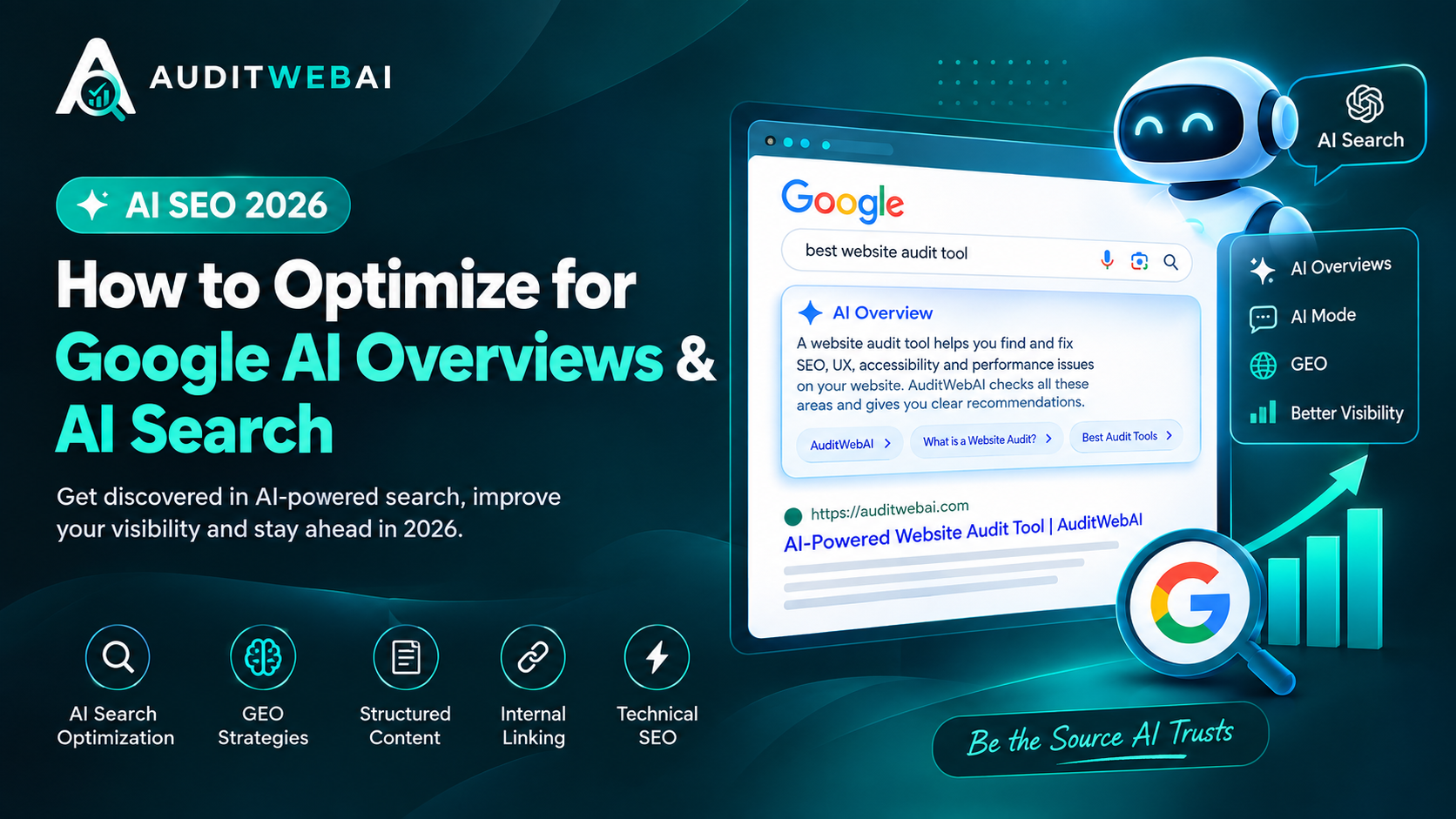
How to Optimize Your Website for Google AI Overviews & AI Search in 2026
Published: September 7, 2026
Category: SEO & AI Search
Reading Time: 12–15 minutes
Search is changing faster than ever.
People are no longer relying only on traditional Google search results. AI-powered search experiences are becoming an increasingly important part of how users discover information, compare products, research businesses, and find answers.
That creates a new opportunity for website owners.
Instead of optimizing only for traditional blue links, businesses should also think about AI search optimization, Google AI Overviews, Google AI Mode, generative search experiences, and other AI-powered discovery systems.
But optimizing for AI search does not mean abandoning traditional SEO.
The fundamentals still matter.
Your website needs to be crawlable, indexable, technically healthy, useful, trustworthy, fast, and easy to understand.
The difference is that your content should also be structured in a way that makes it easier for search systems and AI-powered interfaces to understand the entities, relationships, questions, answers, and expertise covered by your website.
In this guide, you will learn how to optimize your website for AI search in 2026, how AI SEO differs from traditional SEO, what Google AI Overviews mean for website owners, how to improve AI search visibility, and how to build a practical AI SEO strategy.
What Is AI SEO?
AI SEO is the process of optimizing a website so that its content can be discovered, understood, evaluated, and potentially surfaced across AI-powered search experiences.
Traditional SEO focuses heavily on improving visibility in search engine results pages.
AI SEO expands that objective.
Instead of thinking only:
"How can I rank higher for this keyword?"
you should also think:
"How can I become a useful, trustworthy source for this topic?"
AI search systems need to understand more than individual keywords.
They need to understand:
-
Topics
-
Entities
-
Relationships
-
Context
-
Search intent
-
Questions
-
Answers
-
Facts
-
Expertise
-
Website structure
-
Content quality
This makes semantic SEO, topical authority, structured content, and strong technical foundations increasingly important.
Traditional SEO vs AI Search Optimization
Traditional SEO and AI SEO are not completely separate strategies.
They overlap significantly.
| Traditional SEO | AI Search Optimization |
|---|---|
| Keyword targeting | Topic and entity understanding |
| Rankings | Visibility across AI answers |
| SERP clicks | Discovery and qualified traffic |
| Backlinks | Authority and references |
| Search intent | Context and conversational intent |
| Page optimization | Answer-oriented content |
| Technical SEO | Crawlability and machine-readable structure |
| Content optimization | Useful, structured, trustworthy information |
The best strategy is therefore not to replace SEO with AI SEO.
Instead, build a website that is strong for both.
Why AI Search Matters for SEO in 2026
The way people search is becoming more conversational.
Instead of typing:
best website audit tool
a user might ask:
What is the easiest way to find technical SEO problems on a small business website?
Or:
Which website audit tool checks SEO, UX, accessibility and performance together?
These longer questions contain more context.
AI-powered search systems can use that context to provide more detailed responses.
This means websites have an opportunity to become sources for specific questions and topics rather than targeting only short keywords.
Your SEO strategy should therefore move from:
Keyword → Page
toward:
Topic → Questions → Entities → Content → Internal Links → Authority
What Are Google AI Overviews?
Google AI Overviews are AI-generated summaries that can appear within Google Search for certain queries.
Instead of requiring users to open multiple search results immediately, an AI-generated response can summarize information and provide links to supporting sources.
This changes the search experience.
However, appearing in an AI-generated result should not be treated as a guaranteed ranking position or a replacement for traditional organic search.
The fundamentals remain important:
-
Crawlability
-
Indexability
-
Useful content
-
Search intent
-
Technical SEO
-
Page experience
-
Clear site structure
-
Trust
-
Relevant authority
Google's guidance continues to emphasize creating useful, reliable, people-first content rather than producing content primarily to manipulate search rankings.
Therefore, the strongest AI SEO strategy is not writing content "for robots."
It is creating genuinely useful information that machines can also understand.
What Is Google AI Mode?
Google AI Mode is another example of how search is becoming more conversational and exploratory.
Instead of returning only a traditional list of results, AI-powered experiences can help users explore complex questions through follow-up interactions.
This means your content may need to answer more than one version of a question.
For example, instead of publishing only:
What is an SEO audit?
you could create a comprehensive resource covering:
-
What is an SEO audit?
-
Why do you need an SEO audit?
-
What does an SEO audit check?
-
How often should you perform an SEO audit?
-
What technical SEO problems should you look for?
-
How do you fix SEO audit issues?
-
What tools can you use?
-
How long does an SEO audit take?
-
What should you do after an audit?
This creates a much stronger resource around the topic.
10 Ways to Optimize Your Website for AI Search in 2026
1. Build Topical Authority
One of the strongest strategies for AI search optimization is building comprehensive topical coverage.
Instead of publishing unrelated articles every week, create content clusters around your main subject.
For AuditWebAI, a website audit topic cluster could look like:
Website Audit
↓
SEO Audit
↓
Technical SEO Audit
↓
Website Performance Audit
↓
↓
Website Accessibility
↓
↓
AI Search Optimization
↓
Google AI Overviews SEO
↓
SEO Recovery
Each article should connect naturally to other relevant resources.
This creates a clear topical ecosystem.
For example, your existing article:
How to Improve Website SEO in 2026
can link to this new AI search guide.
Your technical SEO guide can also link to this article.
Your Google traffic recovery guide can link here as well.
Your AI SEO audit article can become another important connection.
This is much stronger than having dozens of isolated blog posts.
2. Answer Real Questions
AI search is highly conversational.
That makes question-based content extremely useful.
Instead of focusing only on keywords such as:
AI SEO
create sections answering real questions:
-
What is AI SEO?
-
How does AI search work?
-
How do I optimize for Google AI Overviews?
-
Can SEO help with AI search visibility?
-
What is GEO?
-
How is GEO different from SEO?
-
Does structured data help AI search?
-
How can I make my website easier for AI systems to understand?
-
Does website authority matter for AI search?
-
How should businesses prepare for AI-powered search?
These questions can also help your content capture long-tail search demand.
3. Write Clear, Direct Answers
When answering an important question, don't hide the answer beneath five paragraphs of introduction.
Give a clear answer first.
For example:
What is AI SEO?
AI SEO is the process of optimizing website content and technical structure so search engines and AI-powered search systems can better discover, understand, and potentially surface the information.
Then explain the topic in greater detail.
This structure is useful for both readers and machines.
4. Use Strong Heading Structure
A clear heading structure makes long-form content easier to understand.
For example:
H1:
How to Optimize Your Website for Google AI Overviews & AI Search in 2026
H2:
What Is AI SEO?
H2:
Why AI Search Matters in 2026
H2:
How to Optimize Your Website for AI Search
H3:
Build Topical Authority
H3:
Answer Real Questions
H3:
Improve Technical SEO
H3:
Use Structured Data
This creates a logical content hierarchy.
Avoid adding headings simply because they contain keywords.
Every heading should help the reader navigate the article.
5. Improve Your Technical SEO
AI optimization does not eliminate technical SEO.
In fact, technical SEO remains one of the foundations of search visibility.
Search engines and other systems need to access your website before they can understand its content.
Check:
-
Robots.txt
-
XML sitemap
-
Canonical URLs
-
HTTP status codes
-
Redirects
-
Internal links
-
Mobile usability
-
HTTPS
-
Indexability
-
Crawlability
-
Page rendering
-
JavaScript issues
-
Broken links
If an important page cannot be crawled or indexed, creating better content will not solve the fundamental problem.
This is why you should regularly perform a technical SEO audit.
For a detailed checklist, see:
Technical SEO Audit Checklist 2026
6. Strengthen Internal Linking
Internal linking is one of the easiest improvements you can make on an established website.
Imagine your website contains these articles:
-
AI SEO Audit
-
Technical SEO Audit
-
Website SEO Checklist
-
AI Search Optimization
Don't keep them isolated.
Connect them.
For example:
AI Search Optimization
→ AI SEO Audit
→ Technical SEO Audit
→ Website SEO Checklist
→ Improve Website SEO
→ Why Is My Website Not Ranking?
This creates a connected content network.
Use descriptive anchor text.
Instead of:
Click here
use:
or:
AI SEO audit guide
or:
improve website SEO
The anchor should accurately describe the destination.
7. Create Original and Useful Content
One of the biggest mistakes businesses can make with AI SEO is publishing large amounts of generic AI-generated content.
More pages do not automatically mean more search visibility.
If your website publishes:
-
Repetitive articles
-
Thin content
-
Generic AI summaries
-
Keyword-stuffed pages
-
Pages targeting nearly identical searches
-
Content without original value
you may create a larger website without creating a stronger website.
Instead, add something useful.
For example:
-
Original examples
-
Practical checklists
-
Screenshots
-
Data
-
Experiments
-
Case studies
-
Expert explanations
-
Real-world workflows
-
Unique frameworks
-
Actionable recommendations
AI can help with content production.
But the value should come from the information and experience behind the content.
8. Build Entity and Semantic Relationships
Modern search systems need to understand concepts and relationships.
Consider a website audit platform.
Important entities include:
Website Audit
SEO
Technical SEO
Performance
Accessibility
UX
Google Search
AI Search
AI SEO
These concepts are related.
Your content should explain those relationships naturally.
For example:
A website audit evaluates multiple aspects of website health, including technical SEO, performance, accessibility, user experience, and search visibility.
This gives search systems useful context.
Don't force unrelated keywords into the same paragraph.
Build semantic relationships naturally through comprehensive content.
9. Use Structured Data Where Appropriate
Structured data can help search engines understand specific information on your pages.
Depending on the page type, relevant structured data may include:
-
Article
-
Breadcrumb
-
Organization
-
WebSite
-
SoftwareApplication
-
Product
-
FAQ where appropriate and supported
-
Review where applicable
Structured data should accurately represent visible page content.
Do not add structured data simply to manipulate search results.
If your page says one thing while the structured data claims something completely different, the markup can become misleading.
Use structured data as a way to provide clearer machine-readable context.
10. Improve Website Speed and Core Web Vitals
AI search optimization does not mean ignoring performance.
Your website still needs to provide a good experience.
Important performance areas include:
-
LCP
-
INP
-
CLS
-
Server response time
-
Image size
-
JavaScript execution
-
CSS delivery
-
Caching
-
Mobile performance
Common improvements include:
-
Compressing images
-
Using modern image formats
-
Removing unnecessary scripts
-
Improving caching
-
Reducing page weight
-
Optimizing server response
-
Lazy-loading non-critical images
-
Reducing unnecessary third-party resources
A technically strong website gives users a better experience and provides a stronger foundation for search visibility.
SEO vs GEO: What Is the Difference?
You may have seen the term GEO, which commonly refers to Generative Engine Optimization.
SEO traditionally focuses on improving visibility in search engines.
GEO focuses on improving the likelihood that content is understood and potentially referenced within generative or AI-powered search experiences.
The concepts overlap.
For example, both benefit from:
-
High-quality content
-
Strong technical foundations
-
Clear information
-
Relevant authority
-
Useful internal links
-
Good website structure
-
Strong topical coverage
Therefore, don't treat GEO as a replacement for SEO.
Think of it as an additional optimization layer for an evolving search environment.
How to Make Your Content More AI-Friendly
There is no magic "AI ranking button."
Instead, make your content easier to understand.
Use:
Clear definitions
Explain important concepts in simple language.
Descriptive headings
Tell readers exactly what each section covers.
Short answer sections
Answer important questions directly.
Logical structure
Move from problem → explanation → solution.
Lists
Use lists when information is naturally list-based.
Tables
Use tables when comparing multiple concepts.
Examples
Show how the recommendation works in practice.
Internal links
Connect related topics.
Accurate information
Keep important claims current and verifiable.
This creates content that works well for humans while also being easier for machines to process.
Create Content for Different Search Intent
Not every user wants the same thing.
Search intent can be divided into several broad categories.
Informational Intent
The user wants to learn.
Example:
What is technical SEO?
Create educational content.
Commercial Investigation
The user is comparing options.
Example:
Best website audit tools for small businesses
Create comparison-focused content.
Transactional Intent
The user wants to take action.
Example:
Free website SEO audit
Create a clear product or tool page.
Navigational Intent
The user wants to find a specific website or brand.
Example:
AuditWebAI
Your brand and homepage should clearly communicate what your product does.
Understanding intent helps you create the right page for the right search.
Build an AI Search Content Cluster
If you want to build topical authority around AI SEO, don't publish one article and stop.
Create a cluster.
Pillar Page
AI SEO & AI Search Optimization Guide 2026
Supporting Articles
What Is AI SEO?
How to Optimize for Google AI Overviews
Google AI Mode SEO Guide
GEO vs SEO: What's the Difference?
How to Improve AI Search Visibility
AI SEO Audit Checklist
How to Create AI-Friendly Website Content
Technical SEO for AI Search
How Structured Data Helps Search Engines Understand Your Website
How to Build Topical Authority in 2026
Then connect these articles with internal links.
This gives you a much stronger long-term SEO strategy than publishing random keywords.
How AuditWebAI Fits Into an AI SEO Strategy
Optimizing for AI search starts with a healthy website foundation.
Before focusing on advanced content strategies, you should know whether your website has basic SEO and technical problems.
AuditWebAI is designed to help website owners identify these issues.
The platform analyzes areas including:
-
SEO
-
UX
-
Accessibility
-
Performance
It checks important website signals such as:
-
Title tags
-
Meta descriptions
-
Heading structure
-
Internal links
-
Image ALT attributes
-
Performance signals
-
Accessibility-related issues
-
Website structure
AuditWebAI can then provide prioritized recommendations based on the audit results.
This makes a website audit a useful first step before implementing a broader AI SEO strategy.
Run a free website audit before optimizing your content.
AI SEO Audit Checklist for 2026
Use this checklist before considering your website ready for AI search.
Technical SEO
-
Website is crawlable
-
Important pages are indexable
-
XML sitemap exists
-
Robots.txt is configured correctly
-
Canonical URLs are correct
-
HTTPS is enabled
-
Broken links are fixed
-
Redirects work correctly
-
Important pages return successful status codes
On-Page SEO
-
Every important page has a descriptive title
-
Meta descriptions are useful
-
Pages have logical headings
-
H1 describes the primary topic
-
Images have appropriate ALT text
-
URLs are descriptive
-
Content matches search intent
AI Search Optimization
-
Important questions are answered directly
-
Content covers topics comprehensively
-
Related entities are explained naturally
-
Content has clear structure
-
Supporting articles are internally linked
-
Important facts are accurate
-
Content contains original value
-
Topic clusters are connected
Performance
-
Mobile experience is strong
-
Images are optimized
-
JavaScript is minimized where possible
-
CSS is optimized
-
Server response is reasonable
-
Core Web Vitals are monitored
Content Quality
-
Content is written for people
-
No keyword stuffing
-
No unnecessary repetition
-
No mass-produced low-value pages
-
Content is updated when information changes
-
Articles provide actionable information
-
Important claims are supported by trustworthy sources
7 Common AI SEO Mistakes to Avoid
1. Publishing Hundreds of AI Articles
Using AI does not automatically create high-quality SEO content.
Quality matters more than volume.
2. Stuffing AI Keywords Everywhere
Don't repeatedly write:
AI SEO, AI SEO, AI SEO, GEO, AI SEO 2026
This creates unnatural content.
Use related terminology naturally.
3. Ignoring Traditional SEO
AI search optimization does not replace:
-
Technical SEO
-
Indexing
-
Crawlability
-
Internal linking
-
Performance
-
Search intent
-
Content quality
Your foundation still matters.
4. Creating One Article for Every Tiny Keyword
If five keywords represent the same search intent, you may not need five separate articles.
Instead, create one comprehensive resource.
5. Ignoring Existing Content
Before publishing another article, review your existing pages.
Can you improve:
-
Internal links?
-
Content depth?
-
Search intent?
-
Titles?
-
Headings?
-
Examples?
-
Accuracy?
Sometimes improving an existing article is more valuable than creating another thin page.
6. Forgetting User Experience
Search visibility is not the only goal.
A visitor who lands on your page should be able to:
-
Understand the topic
-
Find the answer
-
Navigate easily
-
Read comfortably
-
Take the next action
SEO should support the user experience, not destroy it.
7. Chasing Guaranteed AI Rankings
Nobody can honestly guarantee that a page will appear in every AI-generated answer.
AI search systems change.
Search results change.
User behavior changes.
The better strategy is to build a website that consistently demonstrates usefulness, relevance, accessibility, and technical quality.
How to Measure AI SEO Success
AI search optimization is still evolving, so don't use a single metric.
Track multiple signals.
Traditional SEO Metrics
Monitor:
-
Organic clicks
-
Impressions
-
Average position
-
CTR
-
Indexed pages
-
Organic sessions
-
Conversions
Content Metrics
Track:
-
Top-performing pages
-
Engagement
-
Returning visitors
-
Content updates
-
Internal-link performance
Business Metrics
Ultimately, monitor:
-
Leads
-
Signups
-
Customers
-
Revenue
-
Conversion rate
The goal is not simply to appear somewhere in an AI answer.
The goal is to increase meaningful discovery and business outcomes.
A Practical AI SEO Strategy for the Next 90 Days
If you're starting from scratch, don't try to optimize everything at once.
Use this roadmap.
Days 1–30: Fix Your Foundation
Start with:
-
Technical SEO
-
Indexing
-
Sitemap
-
Robots.txt
-
Canonicals
-
Broken links
-
Page titles
-
Meta descriptions
-
Heading structure
-
Website speed
Run a complete website audit to identify the highest-priority issues.
Days 31–60: Build Topical Authority
Choose 2–3 core topics.
For example:
Website SEO
Technical SEO
AI Search Optimization
Create one strong pillar article for each topic.
Then publish supporting articles around related questions.
Connect everything through internal links.
Days 61–90: Improve and Measure
Review your existing content.
Find pages with:
-
High impressions
-
Low CTR
-
Positions 5–30
-
Declining traffic
-
Strong business potential
Improve those pages.
Add:
-
Better explanations
-
New examples
-
Internal links
-
Updated information
-
Better headings
-
Clearer answers
Then monitor Search Console and Analytics.
Repeat the process.
Frequently Asked Questions
What is AI SEO?
AI SEO is the process of improving website content, structure, and technical foundations so search engines and AI-powered search systems can better discover and understand the information.
How do I optimize my website for Google AI Overviews?
Focus on strong technical SEO, useful people-first content, clear answers, topical authority, relevant internal linking, accurate information, and a crawlable website. There is no guaranteed method for appearing in an AI Overview.
Is GEO the same as SEO?
No. GEO, or Generative Engine Optimization, generally focuses on visibility within generative or AI-powered search experiences. It overlaps significantly with SEO but emphasizes conversational queries, context, entities, and AI-generated responses.
Does AI SEO replace traditional SEO?
No. Traditional SEO remains the foundation. Technical SEO, indexing, crawlability, content quality, internal linking, performance, and search intent remain important.
Can AI-generated content rank on Google?
AI-assisted content can potentially appear in search results, but using AI does not guarantee rankings. Content should provide real value, be accurate, useful, original where appropriate, and created primarily to help people rather than manipulate rankings.
How can I improve AI search visibility?
Build topical authority, create useful content, answer relevant questions clearly, strengthen internal links, maintain technical SEO, improve website performance, and establish a trustworthy website.
Does structured data help AI search?
Structured data can provide machine-readable context about eligible content and entities. It should accurately represent the visible content on the page and should not be used as a substitute for quality content or technical SEO.
Should I create separate pages for SEO and AI SEO?
Not always. If the search intents overlap significantly, one comprehensive resource may be better. Create separate pages when the topics represent genuinely different user needs.
How often should I update AI SEO content?
Update content when the underlying information, technology, search features, examples, or recommendations change. Avoid changing pages simply to make them appear fresh.
Can an SEO audit improve AI search visibility?
An audit can identify technical, content-structure, performance, accessibility, and SEO issues that may limit website quality or search visibility. Fixing those issues can create a stronger foundation, but an audit cannot guarantee AI search placement.
Final Thoughts
AI is changing how people discover information, but the fundamentals of good SEO have not disappeared.
A successful website in 2026 should be:
Technically accessible.
Easy to understand.
Useful to people.
Fast and mobile-friendly.
Well organized.
Topically relevant.
Internally connected.
Trustworthy.
The biggest mistake is treating AI SEO as a shortcut.
There is no secret prompt, keyword formula, or guaranteed technique that will force a website into AI-generated search results.
Instead, build a website that deserves to be discovered.
Start with a technical SEO foundation.
Create comprehensive content.
Answer real questions.
Build topical authority.
Strengthen internal links.
Improve performance.
Use structured data appropriately.
Monitor your search visibility.
Then continue improving.
For AuditWebAI, this creates an especially strong opportunity because website auditing, technical SEO, performance, accessibility, UX, and AI search optimization naturally fit into the same content ecosystem.
If you want to know what is currently holding your website back, start with a website audit.
Audit your website. Find the problems. Fix what matters. Improve your search visibility.
Ready to Check Your Website?
Run a free AuditWebAI website audit and identify SEO, UX, accessibility, and performance issues that may be limiting your website.
Start Your Free Website Audit