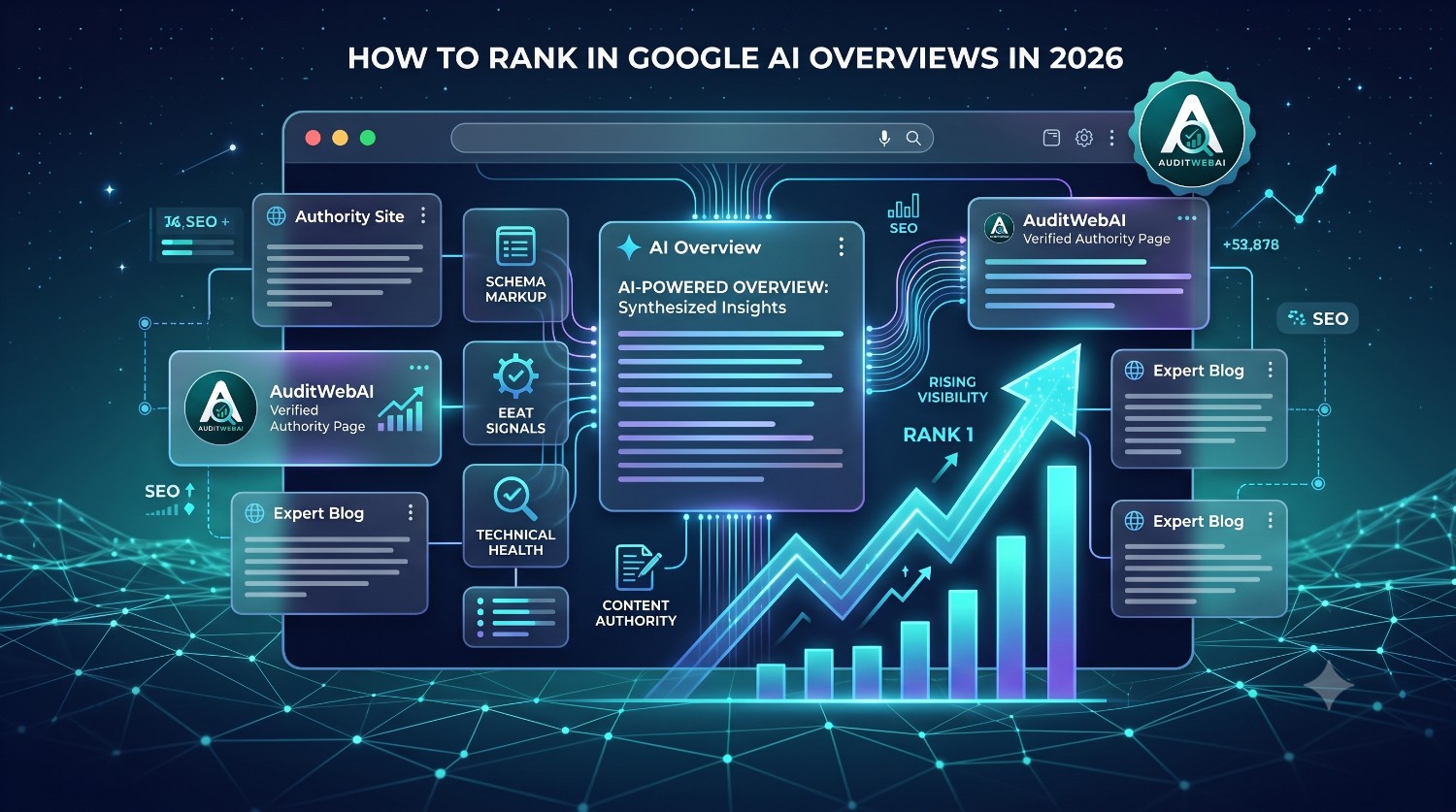
Google Search is changing, and website owners need to think beyond traditional blue-link rankings.
Google AI Overviews and AI Mode can give users AI-generated answers along with links to webpages that help support or expand those answers. That creates a new question for website owners:
How do you rank in Google AI Overviews in 2026?
The answer is not a secret AI ranking trick. Google says the same foundational SEO practices used for Search remain relevant to AI features such as AI Overviews and AI Mode. Your pages still need to meet normal Search technical requirements, be eligible for Search, and provide useful, reliable, people-first content.
What Are Google AI Overviews?
Google AI Overviews are AI-generated summaries that can appear within Google Search for certain queries. Instead of showing only a traditional list of search results, Google may provide a synthesized explanation with links to supporting webpages.
This creates a different path to website discovery. A traditional search journey may look like:
An AI-powered search journey can look more like:
This does not mean that traditional SEO is disappearing. Google’s current documentation says established SEO best practices continue to apply to AI features in Search.
That means your goal should not be to create a completely separate website for AI search. Instead, build a technically healthy website with useful content, clear information architecture, strong internal linking, and content that directly addresses real search intent.
Can You Actually Rank in Google AI Overviews?
Yes, your pages can potentially be shown as supporting links in AI Overviews, but there is no guaranteed position or formula for inclusion.
The word "rank" can be slightly misleading here. Traditional Google Search uses familiar position measurements, while AI Overviews can present multiple supporting sources inside an AI-generated response.
Google states that to be eligible as a supporting link in AI Overviews or AI Mode, a page needs to be indexed and eligible to appear in Google Search with a snippet. Google also states that there are no additional technical requirements specifically for AI Overviews or AI Mode.
In practical terms, your strategy should be:
- Make important pages crawlable.
- Make important pages indexable.
- Publish useful, people-first content.
- Answer real questions clearly.
- Use logical headings and page structure.
- Build relevant internal links.
- Keep important information available as text.
- Improve website performance and usability.
- Measure your search visibility over time.
How to Rank in Google AI Overviews in 2026
The following strategy focuses on practical SEO improvements you can apply to a business website, SaaS website, blog, ecommerce site, or personal website.
Before optimizing specifically for AI search, make sure your normal SEO foundation is healthy.
Check whether your important pages are:
- Crawlable
- Indexable
- Using the correct canonical URL
- Linked internally
- Returning the correct HTTP status
- Included in your sitemap when appropriate
- Not accidentally blocked by robots.txt
- Not unintentionally marked as noindex
Also review your page titles, headings, URLs, internal links, mobile experience, images, structured data, and website performance.
Before trying to improve AI search visibility, you can start with our complete website audit guide .
One of the most important parts of SEO is understanding what the searcher actually wants.
Compare these queries:
- AI SEO
- What is AI SEO?
- How do I optimize my website for Google AI Overviews?
- Why is my website not appearing in AI search?
These queries are related, but the user's intent is different.
If someone searches for a step-by-step guide, give them a step-by-step guide. If someone wants an explanation, explain the concept first. If someone wants to solve a problem, provide a troubleshooting process.
Your article should answer the main question quickly and then provide deeper information.
Conversational search often contains complete questions rather than short keywords.
Structure your content around useful questions such as:
- How do I rank in Google AI Overviews?
- How can I improve AI search visibility?
- Does traditional SEO still matter for AI search?
- How does Google AI Mode find websites?
- Why is my website not appearing in AI search?
- Do I need special schema for AI Overviews?
- How do I measure AI search performance?
Answer the question immediately below the heading, then expand with examples, explanations, and actionable steps.
Your page should have one clear primary purpose. Search engines and users should be able to understand what the page is about without guessing.
Use:
- A descriptive title.
- A clear H1.
- Logical H2 and H3 headings.
- A useful introduction.
- Relevant supporting sections.
- Specific terminology related to the topic.
Avoid creating pages that jump between unrelated topics simply to target a large list of keywords.
AI-powered search does not create a reason for websites to publish generic content. The opposite is true: useful information is more important than ever.
Instead of writing:
explain what the reader should actually do:
Add real value through:
- Original examples
- Practical checklists
- Step-by-step instructions
- First-hand testing
- Useful screenshots
- Troubleshooting instructions
- Original data where you actually have it
- Clear comparisons
- Real implementation examples
Internal linking is especially useful when building an AI-focused SEO content cluster.
Instead of publishing isolated articles, connect related topics together.
For example, this article can naturally connect to:
- Google AI Overviews & AI Mode SEO in 2026
- How to Audit Your Website for AI Search Visibility in 2026
- Free AI Search Visibility Checker
- AI Search Tracking & AI Rank Tracking in 2026
- Generative Engine Optimization (GEO) Guide
- Complete SEO Audit Guide for 2026
Use descriptive anchor text rather than repeatedly using generic phrases such as "click here" or "read more".
A strong AI SEO strategy should not depend on one article. Build a group of closely related pages around your main topic.
Supporting content can cover:
- AI search visibility
- Google AI Mode SEO
- AI search tracking
- Generative Engine Optimization
- Technical SEO
- Website audits
- Google Search Console
- Core Web Vitals
- Website SEO scores
- Indexing problems
This structure gives readers more useful paths through your website and helps organize related information into a coherent topic cluster.
Do not put all of your important information inside images, videos, animations, or complex interfaces.
Important information such as:
- Product explanations
- Pricing details
- Feature descriptions
- How-to instructions
- Important definitions
- Business information
should also be available as readable webpage text.
This helps users, accessibility tools, search engines, and modern search experiences understand the information more easily.
Technical SEO is still the foundation of search visibility.
Review:
- Robots.txt
- XML sitemap
- Canonical URLs
- Indexability
- Noindex directives
- HTTP status codes
- Redirects
- Broken links
- HTTPS
- Mobile usability
For a deeper technical checklist, read our complete SEO audit guide for 2026 .
A page that is difficult to use is not a good experience, regardless of how well the content is written.
Review:
- Large images
- JavaScript
- CSS
- Server response time
- Caching
- Third-party scripts
- Core Web Vitals
- Mobile performance
You can also read our detailed Core Web Vitals guide to understand LCP, INP, and CLS.
Structured data can help Google understand the content on a page and can support eligibility for supported search features.
But you should not add schema simply because you believe it will force a page into AI Overviews.
Google says there is no special structured data requirement specifically for AI Overviews or AI Mode.
When you use structured data, make sure it accurately represents visible page content.
You may see claims online about special AI meta tags, secret files, or a single technical trick that can force your website into AI search results.
Do not build your SEO strategy around these claims.
Google's current documentation says there are no additional technical requirements specifically for appearing in AI Overviews or AI Mode.
Spend your effort on crawlability, useful content, strong information architecture, internal linking, and a healthy website instead.
AI-powered search makes longer and more conversational questions increasingly important.
Instead of targeting only:
create useful content around questions such as:
- How do I optimize my website for Google AI Overviews?
- How can my website appear in AI search?
- Does traditional SEO still matter for AI search?
- How do I improve AI search visibility?
- Why is my website not appearing in Google?
- How can I audit my website for AI search?
Do not repeat these phrases unnaturally. Use them because they represent real questions your audience may have.
Make it obvious what your company does and what problem your website solves.
Your website should clearly communicate:
- Who you are
- What your company does
- What products or services you offer
- Who those products are for
- How your product works
- How users can contact you
A SaaS website, for example, should make its product purpose obvious from the homepage and supporting pages.
AI search and Google Search are constantly evolving. That makes content freshness particularly important for articles about search, SEO, software, or technology.
Review older articles for:
- Outdated Google features
- Old screenshots
- Broken links
- Old terminology
- Previous technical instructions
- Outdated recommendations
- Incorrect references
Keep the useful parts and update the information that has changed.
How to Use Google Search Console for AI Search Visibility
Google Search Console should be one of the main tools in your SEO measurement workflow.
Google's Search Console documentation now includes a Generative AI performance report for Google Search. According to Google, this report can show generative-AI impressions, the pages receiving those impressions, and dimensions such as country and device.
The report covers generative AI features including:
- AI Overviews
- AI Mode
This means you can move beyond manually checking your website and start looking at actual Search Console data.
You should also review the normal Search Console Performance report for:
- Clicks
- Impressions
- Search queries
- Pages
- Click-through rate
- Average position
Learn more in our Google Search Console SEO Guide for 2026 .
How AI Overviews Are Measured in Search Console
Search Console handles AI-powered results differently from a simple traditional ranking position.
Google explains that AI Overviews can contain links to web resources that support the generated overview. A click on an external webpage link inside an AI Overview counts as a click.
Google also explains that an AI Overview occupies a single position in search results, and links inside that AI Overview are assigned that same position.
AI Mode also has its own behavior because users can continue the conversation with follow-up queries.
This is why AI search visibility should be measured using more than a single traditional keyword position.
Google AI Overviews SEO Checklist for 2026
Technical SEO
- Important pages are crawlable.
- Important pages are indexable.
- Correct canonical URLs are used.
- Robots.txt does not accidentally block important content.
- XML sitemap is working correctly.
- Important pages return successful HTTP responses.
- No accidental noindex directives exist.
- HTTPS is working properly.
Content SEO
- The page has a clear search intent.
- The main question is answered quickly.
- The H1 clearly describes the page topic.
- H2 and H3 headings are logical.
- Content is useful and original.
- Content avoids unnecessary repetition.
- Important information is available as text.
- Content is updated when facts change.
Internal Linking
- Important pages receive internal links.
- Related articles are connected.
- Anchor text is descriptive.
- Important pages are not isolated.
- Links are added naturally within relevant content.
Performance & UX
- Images are optimized.
- Large scripts are reviewed.
- Mobile experience is checked.
- Core Web Vitals are monitored.
- Pages are easy to navigate.
- Important actions are easy to complete.
Google AI Overviews vs Traditional SEO
| Traditional SEO | AI Search Visibility |
|---|---|
| Search result rankings | Visibility within AI-powered search experiences |
| Keyword targeting | Questions, topics, entities and intent |
| Organic search results | AI-generated answers and supporting sources |
| Page optimization | Clear information and answer structure |
| Technical SEO | Technical accessibility and Search eligibility |
| Internal linking | Connected topical information |
| Search intent | Conversational and multi-part search intent |
These approaches overlap significantly. The strongest AI-search strategy starts with a strong traditional SEO foundation.
Common Mistakes to Avoid
1. Keyword Stuffing
Do not repeat "how to rank in Google AI Overviews" in every paragraph. Use your primary keyword naturally and rely on related terms where they genuinely improve clarity.
2. Publishing Generic AI Content
Creating dozens of pages that all repeat the same generic advice does not create a strong content resource. Focus on usefulness, accuracy, examples, and clear answers.
3. Creating Fake Statistics
Never add numbers simply to make an article look authoritative. Use verifiable sources when statistics are necessary.
4. Promising Guaranteed AI Rankings
No honest SEO strategy can guarantee that a specific webpage will appear in a specific AI Overview.
5. Ignoring Technical SEO
Adding AI-related keywords will not fix a page that cannot be crawled, indexed, or properly served.
6. Writing Only for Search Engines
Optimize for discovery, but write for people. The page should be genuinely useful even if the visitor never arrives from an AI-powered search feature.
How to Improve AI Search Visibility After an Audit
Once you audit your website, do not try to fix everything simultaneously. Use a priority system.
- Fix critical technical problems first.
- Fix indexing and crawlability issues.
- Improve the structure of important pages.
- Improve content usefulness and search intent alignment.
- Add relevant internal links.
- Improve website performance.
- Measure the results through Search Console and analytics.
If you want to check the overall health of your website before working on AI search visibility, see: How to Audit a Website Step by Step .
How to Rank in Google AI Overviews: Practical 30-Minute Checklist
- Check whether important pages are indexed.
- Review robots.txt.
- Review the XML sitemap.
- Check canonical URLs.
- Check important pages for noindex.
- Review title tags and H1 headings.
- Make the primary topic obvious.
- Answer important questions directly.
- Improve internal links.
- Check for broken links.
- Review Core Web Vitals.
- Check mobile usability.
- Make important information available as text.
- Review structured data for accuracy.
- Update outdated content.
- Monitor Search Console performance.
- Review Google's Generative AI performance report when available.
Frequently Asked Questions
How do I rank in Google AI Overviews?
Focus on the same core SEO principles used for Google Search: make important pages crawlable and indexable, publish useful people-first content, match search intent, use clear headings and internal links, and keep your website technically healthy. There is no guaranteed formula for inclusion in an AI Overview.
Does traditional SEO still matter for Google AI Overviews?
Yes. Google states that established SEO best practices remain relevant to AI features such as AI Overviews and AI Mode.
Do I need special schema for Google AI Overviews?
No. Google says there are no additional technical requirements specifically for AI Overviews or AI Mode and no special structured data requirement for these features.
Can Google guarantee that my page will appear in an AI Overview?
No. Meeting technical requirements and following SEO best practices does not guarantee that Google will crawl, index, or serve a specific page.
How can I measure AI search visibility?
Use Google Search Console's normal Performance reporting along with its Generative AI performance report. The generative AI report provides information about impressions from AI Overviews and AI Mode, including pages, countries, devices, and dates.
Should I create separate pages only for AI search?
Not necessarily. Strong pages can serve both traditional Google Search and AI-powered search experiences. Build useful content around real audience questions instead of creating pages only because a keyword contains the word "AI."
Does internal linking help AI SEO?
Internal linking helps users discover related information and helps search engines understand relationships between pages. It is therefore an important part of a strong website structure.
What is GEO in SEO?
GEO commonly stands for Generative Engine Optimization. It is a term used to describe optimization strategies focused on visibility in generative or AI-powered search experiences.
You can learn more in our Generative Engine Optimization (GEO) guide .
What is AI search visibility?
AI search visibility refers to how easily a website's information can be discovered, understood, and surfaced within AI-powered search experiences.
For a practical checklist, read: How to Audit Your Website for AI Search Visibility in 2026 .
Final Thoughts
Learning how to rank in Google AI Overviews is not about finding a secret keyword formula or special AI ranking tag.
The practical approach is to build a website that is technically accessible, useful, clearly structured, easy to navigate, and genuinely helpful to the people searching for information.
Start with technical SEO. Match search intent. Answer questions directly. Build useful topic clusters. Connect related pages with internal links. Keep important information available as text. Improve performance. Update outdated content. Then measure what happens in Search Console.
AI-powered Search is another layer of website discovery, but strong SEO fundamentals remain the foundation.
Audit → Find Problems → Fix Priorities → Publish Useful Content → Build Internal Links → Measure → Improve
Is Your Website Ready for AI Search?
Find technical SEO, content, performance, UX, accessibility, and website-health issues with a free AuditWebAI website audit.
Run Free Website Audit