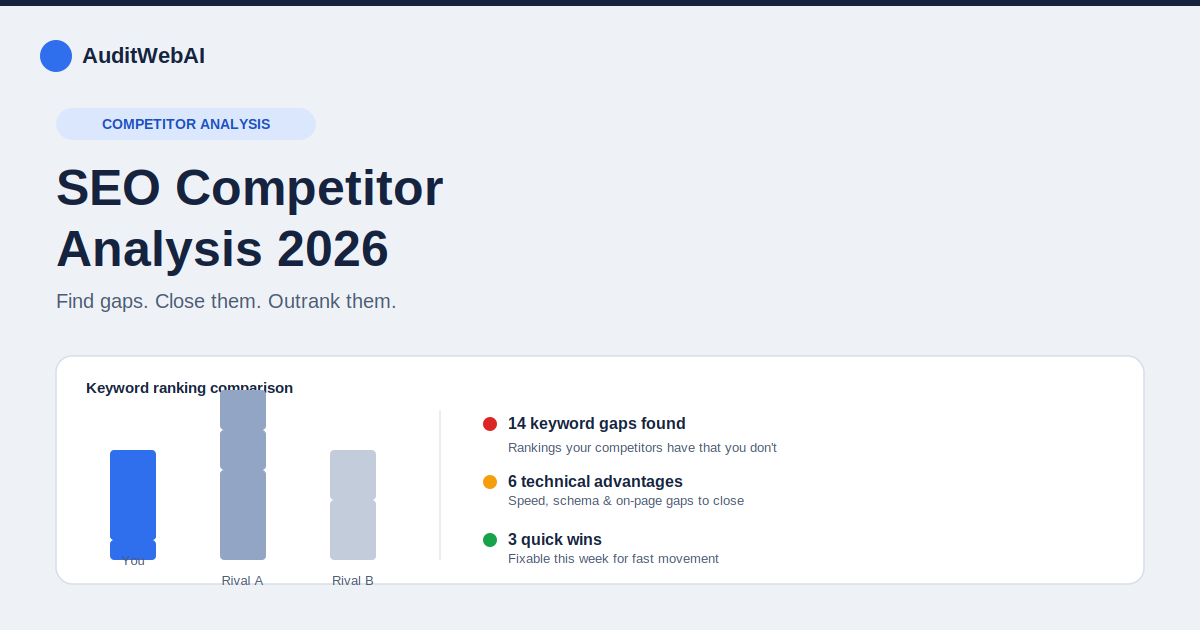
Your biggest SEO competitor probably isn't the business you think of as a rival. It's whoever is sitting in the top five results for the keywords your customers actually search — and in 2026, that fight now happens across Google's classic results, AI Overviews, and AI chat answers at the same time. Here's how to find those real competitors and turn their strengths into your roadmap.
What Is SEO Competitor Analysis?
SEO competitor analysis is the process of studying the websites that outrank you in search to understand their keywords, content, backlinks, and technical setup — then using those insights to close the gaps between your site and theirs. The goal isn't to copy them; it's to understand why Google (and increasingly, AI search) trusts them more for a given query. If you haven't checked your own baseline yet, start by learning how to check your website's SEO score so you know exactly where you're starting from.
Step 1: Find Your Real SEO Competitors
Your SEO competitors are not the same as your business competitors. A local bakery down the street might not appear in search at all, while a recipe blog with zero physical presence could be outranking you for "best sourdough near me." Find your real rivals by:
- Searching your 10-15 most important keywords in an incognito browser and noting which domains consistently show up on page one.
- Looking for domains that repeatedly overlap across multiple of your target keywords, not just one.
- Narrowing your list down to 3-5 true rivals — trying to track everyone dilutes your analysis and wastes time.
Step 2: Compare Keyword Coverage and Gaps
Once you have your shortlist, look at the keywords each competitor ranks for that you don't. These "content gap" keywords are usually your fastest wins, because the competitor has already proven there's search demand and Google is willing to rank a page for it — you just need a better, more complete answer. This is also where a sudden traffic dip on your side becomes clear — if you're losing ground here, see our guide on why Google traffic drops and how to recover it.
Step 3: Audit Their Content Quality
For each keyword gap, open the top-ranking pages and ask: what search intent are they satisfying, and how thoroughly? Look at content depth, use of examples or data, page structure, and how well it answers the follow-up questions a reader would naturally have. Google's own guidance keeps pointing to the same idea — produce something genuinely more useful, not just longer. For a broader framework, our post on 25 proven ways to improve website SEO covers content-side wins in more depth.
Step 4: Check Their Technical and On-Page Advantages
Sometimes a competitor doesn't win with better content — they win with a faster, cleaner, more crawlable site. Compare:
- Page speed and Core Web Vitals scores (LCP, INP, CLS)
- Title tags, meta descriptions, and heading structure
- Internal linking depth to their key pages
- Schema markup usage (FAQ, Article, Product, etc.)
- Accessibility basics like alt text and contrast — increasingly a ranking-adjacent signal, covered in our website accessibility audit checklist
Running through a full technical SEO audit checklist on both your site and theirs side-by-side is the fastest way to spot these gaps.
Step 5: Look at Backlink Profiles
Backlinks are still a strong trust signal. Identify which domains link to your competitors but not to you — these are your most realistic outreach targets, since they've already shown willingness to link to content in your niche.
Step 6: Check AI Search Visibility (AI SEO / GEO)
In 2026, ranking on page one isn't the whole picture. Search a handful of your core queries in Google's AI Overviews and in an AI chat tool, and note which competitors get cited. Citation share in AI answers — often called AI SEO or Generative Engine Optimization (GEO) — is becoming a separate battle from traditional rankings, and it rewards clear structure, direct answers, and credible sourcing over keyword density. Our deep-dive on AI search optimization breaks down exactly how to compete for these AI-generated answers.
Turning Analysis Into Action
- Prioritize by effort vs. impact — fix quick technical wins first, then tackle bigger content gaps.
- Build a content calendar around your top 10-15 gap keywords.
- Set a re-check cadence — competitor positions shift, so revisit this analysis quarterly, not once a year.
Frequently Asked Questions
How many competitors should I analyze?
Three to five true rivals is enough. Tracking too many dilutes your focus and makes the findings harder to act on.
Are my SEO competitors the same as my business competitors?
Not always. Your SEO competitors are whoever ranks above you for your target keywords, regardless of whether they sell the same product or service.
How often should I redo a competitor analysis?
Quarterly is a good baseline for most sites — rankings and competitor content shift often enough that an annual check misses too much.
Find Your Technical Gaps in Minutes
Content and backlink gaps take research, but technical gaps — slow pages, missing schema, weak meta tags — can be found instantly. Run a free AuditWebAI scan on your site to see exactly where you stand before you start chasing competitors. Pair this with our guide on optimizing for Google AI Overviews and GEO and the Technical SEO Audit Checklist to close both content and technical gaps at once.